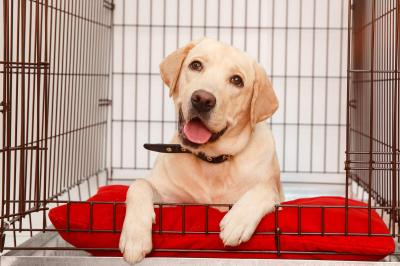
Crate Training Your Dog
Many common behavior problems of older puppies (over 6 months) and adult dogs are caused by separation anxiety, lack of feeling secure when left alone. Crates can be very helpful or very harmful in solving these problems. It all depends on you and how you introduce the crate and how you use it going forward. Crates must be introduced gradually, making every association with the crate as positive and pleasant as possible. While crates help keep your pet from getting into trouble while unsupervised, they should not replace exercise, training and quality time spent together.
Selecting a crate is an important first step. While crates can be expensive, remember that this is a long term investment in your pet's safety. The crate should be big enough for your dog to stand, sit and lie down comfortably, without touching any of the sides. If you're buying a crate for a puppy, keep in mind how big they will be fully grown. Get a crate with a divider so that you can invest in one crate and the space they are allowed to use grows with them. Even if you're not planning on crating them as an adult, keep in mind that there are times when a crate is really helpful: recovering from surgical procedures, guests that the dog may not be comfortable around, workers coming in and out of the house repeatedly and fireworks to name a few.
- Put the crate in an area where the dog feels part of the human activity, but some privacy. Some dogs like a crate with a blanket over it because it feels cozier and more like a den. Yours may or may not, but give each a try.
- Secure the door open so it can't shut unexpectedly and frighten the dog.
- Do not use bedding to start, simple linings of newspaper or the plastic lining are fine. They won't be staying in there, just getting used to the space.
- Encourage the dog to investigate the crate willingly by tossing special training tidbits (cheese, liver, hot dog, something much more tempting than dog food) inside and praising for entering and exiting the crate.
- Once the dog confidently enters and exits the crate, trying placing some bedding inside like a towel or recently worn clothing (t-shirt, sweater or used pillow case).
- Ask the dog to down inside the crate, sitting nearby and petting or talking for short periods.
- Once the dog is again more comfortable, try closing the door while sitting nearby. Do not fold to complaints or praise the dog for anxious or complaining behaviors while in the crate, just sit nearby.
- Once the dog is calm, open the door and let it out.
- Continue and repeat these trainings, eventually moving around the room, then later becoming briefly not visible but still audible.
Important:
- Training is a marathon, not a sprint. Moving forward too fast can set you back quite a bit. Be patient.
- Dogs do what works. If they bark and cause a ruckus and you then let them out - they learn that barking and being unruly is how to get out of the crate. If you only let them out when they're quiet, they learn they're not leaving until they use their manners.
- Do not make a big deal of coming and going from your home. If you spend a lot of time giving kisses and fawning over your dog before you leave and when you return, then there is a drastic difference between that and when you're gone. Your absence is felt so much more which can cause your dog to have uneasy feelings about your absence. If you put a Kong or other treats in the crate for your dog as part of your routine to leave (pack your lunch, gather the things you need, put a Kong in the crate, put on your coat, put your dog in their crate, get your keys, check that the doors are locked and then leave) and then let them out as part of your return (come home, hang up keys, put away mail, let them out of the crate and go directly outside to go potty, put away anything you brought home, then give them some loving) then they will be calmer with both your exit and return home. They'll be easier to handle on your return as they will not get quite as wound up and they will be less inclined to develop separation anxiety.
- Continue to make the crate a happy place. Even after you start using the crate while you're asleep or away from home, continue to put treats in the crate occasionally. They shouldn't think that every time they go in there, the door is closing and you're leaving.
VetStreet has a nice video with more tips to crate train an adult dog.
Hill's Science Diet has interesting information specifically for crate training an older dog here.
Back to FAQs